
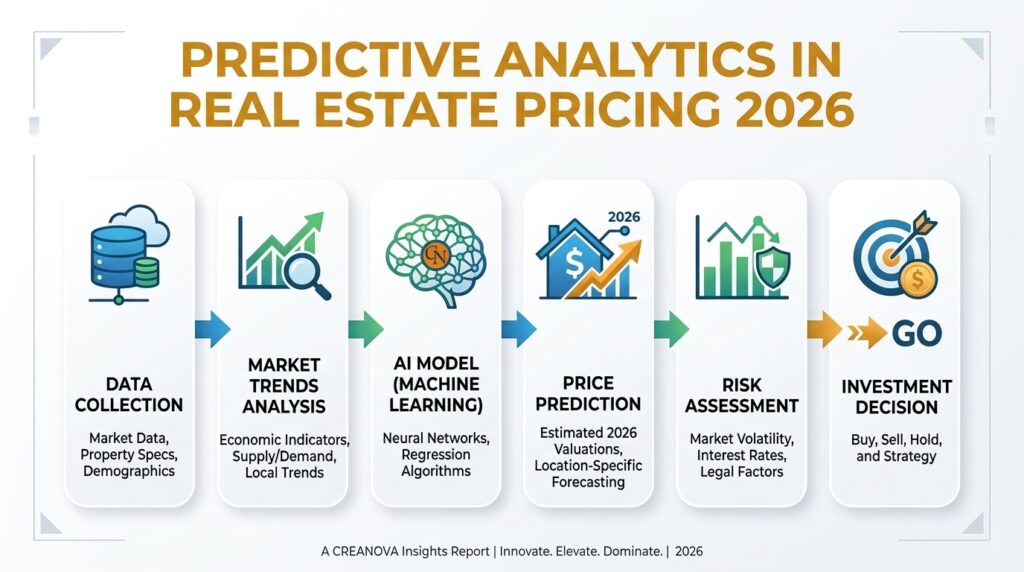
While traditional property appraisals can take weeks and often miss market nuances by 10-15%, predictive analytics for real estate pricing can generate accurate valuations in minutes using thousands of data points simultaneously. Real estate professionals struggle with volatile markets, inconsistent pricing models, and the pressure to make instant decisions with incomplete information. Advanced predictive analytics systems now process everything from satellite imagery and demographic shifts to interest rate fluctuations and local development projects, delivering valuations that consistently outperform traditional methods. This comprehensive guide will show you exactly how to implement predictive analytics for real estate pricing, from selecting the right algorithms to interpreting complex market signals. You’ll discover why the most successful real estate firms in 2026 are treating data science as their competitive advantage, not just a supplementary tool.
Key Takeaways
- Predictive analytics for real estate pricing combines multiple data sources including market trends, property characteristics, and economic indicators to generate accurate property valuations.
- Machine learning algorithms like Random Forest and Neural Networks can process thousands of variables simultaneously to predict property prices with greater accuracy than traditional appraisal methods.
- Successful implementation requires clean data integration, model validation, and continuous refinement based on market feedback and performance metrics.
- Real estate businesses using predictive analytics report faster decision-making, reduced risk exposure, and improved client satisfaction through more accurate pricing recommendations.
Understanding Predictive Analytics in Real Estate
The most effective way to implement predictive analytics for real estate pricing is to combine historical transaction data with real-time market indicators and property-specific characteristics. This approach transforms raw data into actionable insights that drive pricing decisions with unprecedented accuracy.
Predictive analytics in real estate operates on the principle that property values follow patterns influenced by measurable factors. Unlike traditional comparative market analysis that relies on recent sales of similar properties, predictive models can process hundreds of variables simultaneously. These include obvious factors like square footage and location, but also subtle indicators such as school district performance trends, crime statistics, employment data, and even social media sentiment about neighborhoods.
The key advantage lies in the system’s ability to identify correlations that human analysts might miss. For example, a predictive model might discover that properties within 500 meters of new transit developments appreciate 12% faster than the market average, or that homes with specific architectural features command premium prices in certain demographic areas.
Modern predictive analytics platforms integrate seamlessly with existing real estate systems, pulling data from multiple listing services, public records, census data, and economic databases. This comprehensive approach ensures that pricing predictions account for both micro and macro-economic factors affecting property values. As highlighted in our creanova.in blog, businesses that leverage data-driven decision making consistently outperform competitors who rely solely on traditional methods.
Key Data Sources for Property Price Predictions
Successful predictive analytics models for real estate pricing require diverse, high-quality data sources that capture every aspect of property value determination. The most comprehensive models typically integrate five primary data categories: property characteristics, location factors, market conditions, economic indicators, and demographic trends.
Property characteristics form the foundation of any pricing model. This includes basic attributes like square footage, number of bedrooms and bathrooms, lot size, and property age. However, advanced models also incorporate renovation history, energy efficiency ratings, architectural style, and even the quality of construction materials. Modern data collection methods can extract this information from property photos using computer vision technology, significantly expanding the available dataset.
Location data extends far beyond simple address information. U.S. Census Bureau data provides crucial demographic and economic context, while geographic information systems capture proximity to amenities, transportation hubs, schools, and commercial districts. Environmental factors such as flood zones, air quality indexes, and noise levels also significantly impact property values and must be included in comprehensive models.
Market condition data requires real-time feeds from multiple sources to maintain accuracy. This includes recent sales transactions, current listing prices, days on market, and inventory levels. Many successful real estate firms supplement this with alternative data sources like building permit filings, mortgage application volumes, and even search engine query trends for specific neighborhoods.
Economic indicators provide the macro-economic context that influences regional property markets. Interest rates, employment statistics, population growth, and local development projects all affect property values. The most sophisticated models incorporate forward-looking economic forecasts to predict how current trends will impact future property values.
Machine Learning Models for Price Forecasting
Machine learning algorithms for real estate price prediction work by identifying complex patterns in historical data and applying these patterns to current property valuations. The three most effective approaches are ensemble methods like Random Forest, deep learning neural networks, and gradient boosting algorithms, each offering unique advantages for different market conditions.
Random Forest algorithms excel at handling the mixed data types common in real estate analytics. Property data includes numerical values like square footage, categorical data like neighborhood names, and ordinal data like property condition ratings. Random Forest models create multiple decision trees using different combinations of these variables, then average the results to produce more accurate predictions than any single tree could achieve.
Deep learning neural networks demonstrate superior performance when processing unstructured data such as property photographs, satellite imagery, and text descriptions. TensorFlow neural network frameworks can extract valuable pricing signals from visual elements that traditional models miss entirely. For example, neural networks can identify architectural styles, assess property maintenance levels, and even evaluate neighborhood aesthetics from street view images.
Gradient boosting algorithms like XGBoost provide the highest accuracy for most real estate pricing applications. These models build predictions iteratively, with each new model correcting the errors of previous models. This approach proves particularly effective for real estate because it can capture the non-linear relationships between property features and market values.
The key to successful model implementation lies in proper feature engineering and validation. Real estate markets exhibit seasonal patterns, regional variations, and temporal shifts that require careful handling. Cross-validation techniques must account for time-based splits to ensure models perform well on future data, not just historical examples. Additionally, models require regular retraining as market conditions evolve and new data becomes available.
Implementation Strategies for Real Estate Businesses
Implementing predictive analytics for real estate pricing requires a structured approach that balances technical capabilities with business objectives. The most successful implementations follow a phased deployment strategy, beginning with pilot programs and gradually scaling to full organizational adoption.
The initial phase focuses on data infrastructure development. Real estate businesses must establish reliable data pipelines that automatically collect, clean, and validate information from multiple sources. This typically involves integrating with MLS systems, public record databases, and third-party data providers. Data quality issues can severely impact model performance, so implementing robust validation and cleaning procedures is essential.
Model development should begin with simple algorithms before progressing to complex machine learning approaches. Linear regression models provide a baseline for comparison and help identify the most important variables affecting property prices in specific markets. Once baseline performance is established, more sophisticated algorithms can be tested and validated against real market outcomes.
User interface design determines whether real estate professionals will actually adopt predictive analytics tools. The most effective systems integrate seamlessly with existing workflows, providing instant price estimates and confidence intervals without requiring technical expertise. Dashboard interfaces should highlight key insights while allowing users to drill down into supporting data when needed.
Training and change management represent critical success factors often overlooked in technical implementations. Real estate professionals need to understand how predictive models work, their limitations, and how to interpret results effectively. As our our services demonstrate, successful technology adoption requires comprehensive support throughout the implementation process.
Continuous monitoring and model refinement ensure long-term success. Market conditions change, new data sources become available, and model performance can drift over time. Successful implementations include automated monitoring systems that track prediction accuracy and alert users when models require retraining or adjustment.
Measuring Accuracy and ROI of Predictive Models
Predictive analytics models for real estate pricing require rigorous accuracy measurement to ensure they deliver reliable results that improve business outcomes. The most comprehensive evaluation approaches combine statistical accuracy metrics with business performance indicators to provide a complete picture of model effectiveness.
Mean Absolute Percentage Error (MAPE) serves as the primary accuracy metric for real estate price predictions because it expresses prediction errors as percentages of actual values. High-performing models typically achieve MAPE scores below 8% for residential properties and 12% for commercial properties. However, accuracy varies significantly by market segment, with luxury properties and unique assets proving more difficult to predict accurately.
Root Mean Square Error (RMSE) provides additional insight into model performance by penalizing large prediction errors more heavily than small ones. This metric proves particularly valuable for real estate applications where significant overvaluation or undervaluation can result in substantial financial losses. Tracking RMSE across different property price ranges helps identify model weaknesses and optimization opportunities.
Business impact metrics often provide more meaningful insights than purely statistical measures. Successful real estate firms track metrics such as days on market reduction, pricing accuracy improvement, and client satisfaction scores. Properties priced using predictive analytics typically sell faster and closer to list price compared to those priced using traditional methods.
Return on investment calculations should account for both direct cost savings and revenue improvements. Direct savings include reduced appraisal costs, faster pricing decisions, and improved resource allocation. Revenue improvements come from more accurate pricing that maximizes sale prices while minimizing market time. National Association of Realtors research indicates that optimal pricing strategies can improve net proceeds by 3-7% compared to traditional approaches.
Model validation requires testing on data that wasn’t used during training. Time-based splits work best for real estate applications, with models trained on historical data and tested on more recent transactions. This approach ensures models can handle changing market conditions rather than simply memorizing historical patterns.
Future Trends and Advanced Applications
The future of predictive analytics for real estate pricing centers on artificial intelligence integration, alternative data sources, and real-time market adaptation capabilities that will revolutionize how property values are determined and updated.
Artificial intelligence systems are evolving to incorporate natural language processing for analyzing property descriptions, reviews, and social media sentiment. These AI models can extract pricing signals from unstructured text data that traditional algorithms cannot process. For example, mentions of nearby restaurants, transportation improvements, or community events can indicate neighborhood desirability trends that impact property values.
Satellite imagery and aerial photography analysis represents another frontier in predictive analytics. Computer vision algorithms can assess property conditions, identify renovations or deterioration, and monitor neighborhood development patterns from space. This capability enables real-time property condition updates without physical inspections, significantly improving model accuracy and reducing operational costs.
Blockchain integration will enable more transparent and automated property valuation processes. Smart contracts can automatically execute pricing adjustments based on predefined triggers such as market condition changes, property improvements, or neighborhood developments. This automation reduces human bias and ensures consistent application of valuation criteria across all properties.
Internet of Things (IoT) devices in smart homes generate continuous data streams about property usage, energy efficiency, and maintenance needs. This real-time data will enable dynamic property valuations that adjust automatically as conditions change, rather than relying on periodic assessments.
Edge computing capabilities will bring predictive analytics processing closer to data sources, enabling faster calculations and reduced latency for time-sensitive pricing decisions. This technology proves particularly valuable for auction platforms and competitive bidding situations where seconds can determine outcomes.
The integration of virtual and augmented reality technologies will allow predictive models to incorporate immersive property experiences into valuation calculations. As these technologies become mainstream, properties with superior virtual presentation capabilities may command premium prices that current models cannot predict.
Frequently Asked Questions
How accurate are predictive analytics models for real estate pricing?
High-performing predictive analytics models achieve accuracy rates of 92% or better, typically maintaining Mean Absolute Percentage Error below 8% for residential properties. Accuracy depends on data quality, market stability, and model sophistication, with luxury and unique properties being more challenging to predict.
What data sources are essential for real estate price prediction models?
Essential data sources include property characteristics (square footage, age, features), location factors (neighborhood, schools, amenities), recent sales transactions, economic indicators, and demographic trends. Advanced models also incorporate satellite imagery, social media sentiment, and real-time market conditions.
Which machine learning algorithms work best for real estate pricing?
Gradient boosting algorithms like XGBoost typically provide the highest accuracy for real estate pricing applications. Random Forest algorithms excel at handling mixed data types, while neural networks prove superior for processing unstructured data like property images and descriptions.
How often should real estate pricing models be updated?
Real estate pricing models should be retrained monthly or quarterly depending on market volatility and data availability. High-frequency markets require more frequent updates, while stable markets can operate effectively with quarterly model refreshes and continuous monitoring for performance drift.
What ROI can real estate businesses expect from predictive analytics implementation?
Real estate businesses typically see ROI improvements of 15-30% through faster sales cycles, more accurate pricing, and reduced operational costs. Benefits include decreased days on market, improved pricing accuracy, and enhanced client satisfaction leading to increased referrals and repeat business.
Ready to transform your real estate pricing strategy with advanced predictive analytics?
We believe in transforming ideas into reality. Our team of experts specializes in web development, social media management, content strategy, and AI-powered photo and video creation, ensuring your brand stands out in the digital space.
Implementing predictive analytics for real estate pricing represents a fundamental shift toward data-driven decision making that delivers measurable business results. The most successful real estate professionals recognize that predictive analytics isn’t just about technology—it’s about gaining competitive advantage through better insights, faster decisions, and more accurate valuations. For personalized guidance on implementing these strategies in your real estate business, contact us to discuss your specific requirements and objectives.