While most healthcare organizations spend months evaluating enterprise healthcare IT consulting firms, the majority make their final decision based on just three critical factors that most buyers overlook entirely. Healthcare IT transformations fail at alarming rates, often due to misaligned consultant selection rather than technology limitations. Organizations that follow a structured evaluation framework achieve 40% faster implementation times and significantly better ROI outcomes. This guide reveals the essential criteria for selecting enterprise healthcare IT consulting firms, proven evaluation methodologies, and insider insights from successful digital health transformations. You’ll discover why the lowest bidder often becomes the most expensive choice and how leading healthcare systems identify consulting partners that deliver measurable results.
Key Takeaways
- Enterprise healthcare IT consulting firms must demonstrate proven HIPAA compliance and healthcare-specific experience beyond general IT consulting.
- The most effective healthcare IT consultants focus on interoperability, data migration, and regulatory compliance as core competencies.
- Successful healthcare IT implementations require consultants with deep understanding of clinical workflows and patient safety protocols.
- Cost evaluation should prioritize total project value and long-term support capabilities over initial consulting fees alone.
Market Landscape and Key Players
The most effective way to evaluate enterprise healthcare IT consulting firms is to understand their specialization depth within healthcare-specific challenges rather than general technology expertise. The healthcare IT consulting market has evolved significantly, with firms increasingly focusing on niche areas like Epic implementations, FHIR integration, and telehealth infrastructure.
Major consulting firms typically fall into three categories: global technology consultants with healthcare divisions, specialized healthcare IT firms, and regional players with deep local market knowledge. Each category offers distinct advantages depending on your organization’s size, complexity, and geographic footprint.
Global technology consultants bring extensive resources and cross-industry best practices but may lack the nuanced understanding of healthcare workflows that smaller, specialized firms possess. Companies like Accenture, Deloitte, and IBM have substantial healthcare practices with proven track records in large-scale transformations.
Specialized healthcare IT consulting firms focus exclusively on healthcare challenges, offering deeper clinical knowledge and regulatory expertise. These firms understand the unique complexities of patient data management, clinical decision support systems, and healthcare interoperability standards.
For organizations seeking comprehensive digital transformation support, exploring our services can provide valuable insights into modern healthcare IT consulting approaches.
Essential Evaluation Criteria
Healthcare IT consulting requires specific competencies that extend far beyond traditional technology implementation. The most critical evaluation factors center on healthcare domain expertise, regulatory compliance knowledge, and proven clinical workflow integration experience.
According to HHS cybersecurity guidance, healthcare organizations must ensure their consulting partners maintain robust security frameworks and compliance protocols throughout the engagement.
Regulatory compliance expertise distinguishes healthcare IT consultants from general technology firms, requiring deep knowledge of HIPAA, HITECH, and emerging privacy regulations. Evaluate consultants based on their specific experience with healthcare compliance audits, breach response procedures, and ongoing monitoring capabilities.
Clinical workflow integration represents another critical differentiator. Effective healthcare IT consultants understand how technology changes impact patient care delivery, provider efficiency, and clinical outcomes. They can articulate specific strategies for change management within clinical environments.
Technical competencies should include experience with major healthcare platforms like Epic, Cerner, Allscripts, and emerging FHIR-based solutions. Consultants should demonstrate proficiency in healthcare data standards, including HL7, DICOM, and IHE profiles.
Core Service Specializations
Enterprise healthcare IT consulting encompasses multiple specialized service areas, each requiring distinct expertise and proven methodologies. The most valuable consultants offer integrated capabilities across these domains rather than point solutions.
Electronic Health Record (EHR) implementation and optimization represents the largest service category. This includes system selection, configuration, data migration, workflow design, and ongoing optimization. Successful EHR consultants demonstrate measurable improvements in clinical efficiency and user satisfaction.
Interoperability consulting focuses on connecting disparate healthcare systems to enable seamless data exchange and care coordination across providers. This specialization has become increasingly critical as healthcare organizations expand their digital ecosystems.
Healthcare data analytics and business intelligence consulting helps organizations leverage clinical and operational data for improved decision-making. This includes data warehouse design, reporting system implementation, and advanced analytics platform deployment.
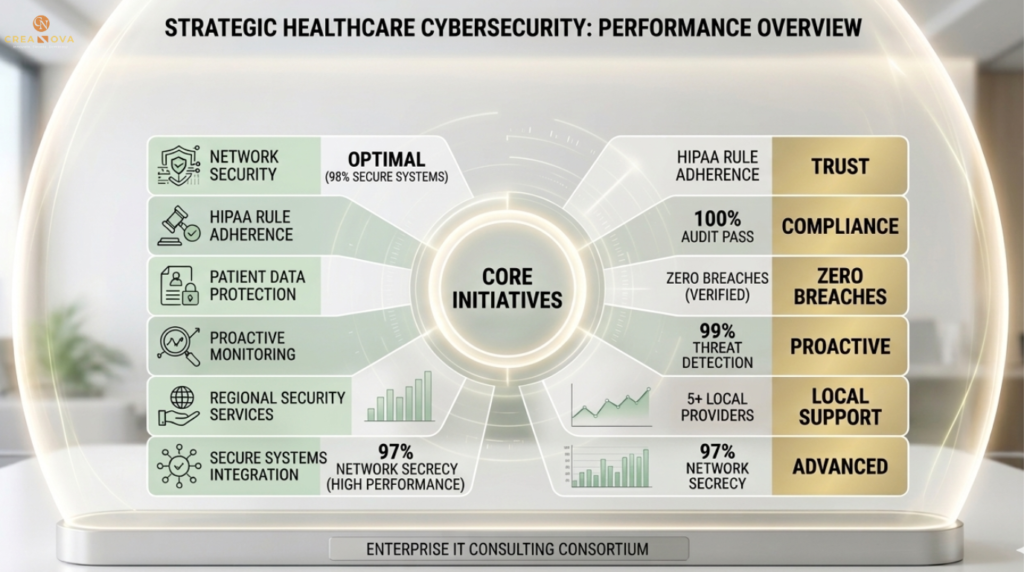
Cybersecurity consulting specifically tailored for healthcare environments addresses unique vulnerabilities and compliance requirements. The Cybersecurity and Infrastructure Security Agency provides specific guidance for healthcare organizations that qualified consultants should understand thoroughly.
For healthcare organizations exploring comprehensive IT strategy development, our creanova.in blog offers insights into emerging healthcare technology trends and implementation strategies.
Implementation Methodologies
Successful healthcare IT implementations require methodologies specifically adapted for clinical environments, where system downtime can directly impact patient safety and care delivery. The most effective consulting firms employ proven frameworks that minimize disruption while ensuring comprehensive testing and validation.
Agile implementation approaches have gained popularity in healthcare IT, allowing for iterative development and continuous feedback from clinical users. However, healthcare implementations require careful balance between agility and the rigorous validation needed for patient safety systems.
Phased implementation strategies reduce risk by enabling gradual system rollouts across different departments or locations, allowing for refinement and optimization before full deployment. This approach particularly benefits large healthcare systems with multiple facilities and diverse clinical specialties.
Change management methodologies must address the unique challenges of healthcare environments, including shift work patterns, clinical urgency, and varying technology comfort levels among healthcare professionals. Effective consultants employ clinical champions and peer-to-peer training approaches.
Testing and validation protocols in healthcare IT consulting must exceed standard software testing to include clinical scenario testing, patient safety validation, and regulatory compliance verification. Consultants should demonstrate specific experience with healthcare testing methodologies.
Cost Factors and Pricing Models
Healthcare IT consulting costs vary significantly based on project scope, timeline, and consultant expertise level. Understanding pricing models and cost factors enables more accurate budget planning and vendor comparison.
Time and materials pricing provides flexibility for projects with evolving requirements but requires careful scope management to control costs. This model works well for advisory services and ongoing optimization projects where requirements may shift based on clinical feedback.
Fixed-price engagements offer budget certainty but require detailed scope definition upfront, making them suitable for well-defined implementation projects with clear deliverables. Healthcare organizations should ensure change management processes are clearly defined in fixed-price contracts.
Value-based pricing models tie consultant compensation to specific outcomes like user adoption rates, system performance metrics, or operational efficiency improvements. While less common, these models can align consultant incentives with organizational goals.
Total cost of ownership considerations should include ongoing support, maintenance, training, and optimization services beyond initial implementation. Many healthcare organizations underestimate these ongoing costs when evaluating consulting proposals.
Strategic Selection Framework
Developing a structured selection process improves consulting partner evaluation and increases the likelihood of successful project outcomes. The most effective selection frameworks emphasize healthcare-specific criteria while maintaining objective evaluation standards.
Request for Proposal (RFP) development should include specific healthcare scenarios and use cases that allow consultants to demonstrate their clinical knowledge and technical capabilities. Include questions about regulatory compliance, patient safety protocols, and clinical workflow optimization.
Reference checking in healthcare IT consulting should focus on similar-sized organizations with comparable clinical complexities rather than just technical implementations. Contact references directly to discuss specific challenges, outcomes, and ongoing relationships with the consulting firm.
Pilot project approaches allow organizations to evaluate consultant capabilities on a smaller scale before committing to larger engagements. This strategy provides valuable insights into working relationships, communication styles, and technical competencies.
Contract negotiation should address healthcare-specific requirements including HIPAA compliance, business associate agreements, data security protocols, and clinical workflow disruption minimization. Ensure clear performance metrics and accountability measures are established.
For healthcare organizations ready to begin their consulting partner evaluation process, we invite you to contact us to discuss your specific requirements and learn how our healthcare IT expertise can support your transformation goals.
Frequently Asked Questions
What qualifications should healthcare IT consultants have?
Healthcare IT consultants should possess healthcare-specific certifications, HIPAA compliance training, and proven experience with major EHR platforms. They must demonstrate understanding of clinical workflows, regulatory requirements, and patient safety protocols beyond general technology expertise.
How long do typical healthcare IT consulting engagements last?
Healthcare IT consulting engagements typically range from 6 months for focused implementations to 2-3 years for comprehensive digital transformations. EHR implementations average 12-18 months, while interoperability projects often require 6-12 months depending on system complexity.
What is the average cost of enterprise healthcare IT consulting?
Enterprise healthcare IT consulting costs vary from $150-400 per hour for specialists, with project-based engagements ranging from $100,000 for focused implementations to several million for comprehensive system transformations. Total costs depend on scope, timeline, and organizational complexity.
How do I evaluate healthcare IT consultant references?
Evaluate healthcare IT consultant references by contacting similar-sized healthcare organizations directly, focusing on clinical workflow improvements, user adoption rates, and ongoing support quality. Ask specific questions about regulatory compliance, project timelines, and post-implementation satisfaction levels.
What should be included in healthcare IT consulting contracts?
Healthcare IT consulting contracts must include HIPAA business associate agreements, data security protocols, clinical workflow disruption minimization requirements, and specific performance metrics. Include clear scope definitions, change management processes, and ongoing support arrangements.
Selecting the right healthcare IT consulting partner requires deep industry expertise and proven implementation experience.
We believe in transforming ideas into reality. Our team of experts specializes in web development, social media management, content strategy, and AI-powered photo and video creation, ensuring your brand stands out in the digital space.